TechDays 2011: Rx talk, slides and source code

Rx, Silverlight, Windows Phone, WPF 3 Comments »

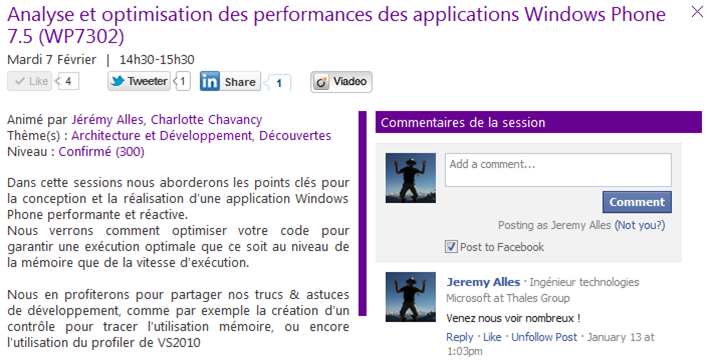
As promised, here is a blog post which shares source code and slides for the Rx talk I gave during last TechDays in Paris. I animated this session with my co-worker Charlotte and with Mitsu.

Download slides here.
Download source code here.

Demo1: Drag’n'drop in a WPF application

The goal was to implement a basic drag’n'drop functionality in a WPF application. The Rx query looks like the following:

?View Code CSHARP
1
2
3
4
5
6
7
8
9
10
11
12
13
14
var query = from mouseDown in this.image.GetMouseLeftButtonDownObservable()
            let downPosition = mouseDown.EventArgs.GetPosition(this)
            let rect = new Rect(downPosition.X - 10, downPosition.Y - 10, 20, 20)
            let delta = mouseDown.EventArgs.GetPosition(this.image)
            from mouseMove in this.GetMouseMoveObservable()
                .Select(ea => ea.EventArgs.GetPosition(this))
                .SkipWhile(p => rect.Contains(p))
                .DoOnce(p => this.onMouseEnter.Begin(this.image))
                .Select(p => p.Offset(delta))
                .TakeUntil(this.GetMouseLeftButtonUpObservable())
                .Finally(() => this.onMouseLeave.Begin(this.image))
            select mouseMove;
 
query.Subscribe(p => this.image.SetPosition(p));


Demo2: online Twitter search and Bing map geolocalization

This time, the goal was to query Twitter asynchronously and to geolocalize the associated Tweets. The Rx query:

?View Code CSHARP
1
2
3
4
5
6
7
8
9
10
11
12
13
14
15
16
this.textbox.GetTextChangedObservable()
    .DistinctUntilChanged((ea) => this.textbox.Text)
    .Throttle(TimeSpan.FromMilliseconds(300))
    .ObserveOnDispatcher()
    .Do(ea => this.ShowLoadingIndicator())
    .Select(ea => TweeterHelper.Search(this.textbox.Text))
    .Switch()
    .ObserveOn(Scheduler.Dispatcher)
    .Select(page => TweeterHelper.ParseTwitterSearch(page))
    .Subscribe((tweets) =>
                    {
                        this.HideLoadingIndicator();
                        this.listbox.ItemsSource = tweets;
 
                        TweeterHelper.LocalizeTweets(this.map, tweets);
                    });


Demo3: using the accelerometer in a Windows Phone 7 application

The last demo was about the usage of the accelerometer in a Windows Phone 7 application. Here is the relevant Rx query:

?View Code CSHARP
1
2
3
4
5
6
7
8
9
10
private void MoveEllipse(IObservable<Acceleration> accelerationObservable)
{
    accelerationObservable
        .SlidingBuffer(2)
        .Select(accCouple => new Acceleration(accCouple.First(), accCouple.Last()))
        .ObserveOnDispatcher()
        .Do(acc => this.textBlock.Text = acc.ToString())
        .Scan(new Point(x0, y0), (point, acc) => point.Move(acc).ClipTo(horizontalInterval, verticaInterval))
        .Subscribe(p => this.ellipse.SetCenter(p));
}

Doing this session was a really great experience ! I’d like to thank Charlotte and Mitsu for doing it with me. Also, I’d like to thank all users who came to the presentation !

TechDays 2011: Rx talk in Paris

Rx, Silverlight, Windows Phone, WPF 3 Comments »

During the next 3 days, the “Palais des Congrès” in Paris will hosting the TechDays 2011. For the very first time, I’ll have the chance to be part of it as a speaker for a talk about Rx (Reactive Extensions).

The session will take place in room 241, tomorrow Thursday 8, from 1pm to 2pm. Here is the link to the session’s description (in French).

I’ll share presentation slides and source code by the end of the week :-)

MVVM Framework Explorer update and top MVVM Frameworks

Silverlight, Windows Phone, WPF 2 Comments »

A couple of days ago I received an email from Geert van Horrik, a developer working on a new MVVM Framework called Catel. Geert asked me to update my MVVM Framework Explorer app in order to include his new framework. Here is the resulting updated app (click to launch):

Besides adding this new framework, I updated the download count for each framework, which allowed me to do some statistics. Here are the download progression for the most popular MVVM frameworks between July 2010 and January 2011:

Framework July 2010 January 2011 Progression
Calcium 7486 9963 33%
Caliburn 27012 36392 35%
Cinch 9865 15206 54%
CoreMVVM 3373 4419 31%
MEFedMVVM 905 2074 129%
MVVM Foundation 5759 7656 33%
MVVM Helpers 674 1571 133%
MVVM Light 11601 30111 160%
NitoMVVM 446 1098 146%
nRoute 7638 13724 80%
Onyx 2027 2195 8%
WAF 12255 30673 150%

Top progression during the last 6 months:

  1. MVVM Light (by Laurent Bugnion): +160%
  2. MVVM Helpers (by Mark Smith): +133%
  3. MEFedMVVM (by Marlon Grech): +129%
  4. WAF (by Jurgen Berchtel): +150%

Top downloaded frameworks:

  1. Caliburn (by Rob Eisenberg): +36 000 downloads
  2. MVVM Light (by Laurent Bugnion): +30 000 downloads
  3. WAF (by Jurgen Berchtel): +30 000 downloads

Congratulations to their respective authors.

Calcium 7486 9963 33%
Caliburn 27012 36392 35%
Cinch 9865 15206 54%
CoreMVVM 3373 4419 31%
MEFedMVVM 905 2074 129%
MVVM Foundation 5759 7656 33%
MVVM Helpers 674 1571 133%
MVVM Light 11601 30111 160%
NitoMVVM 446 1098 146%
nRoute 7638 13724 80%
Onyx 2027 2195 8%
WAF 12255 30673 150%

Tap N Match a cool WP7 game ! Vote on Facebook !

Events, Silverlight, Windows Phone 4 Comments »

Today I need help from all my readers across the globe ! Please vote for our TapNMatch WP7 game here

Microsoft France is organizing since a couple of months a Windows Phone 7 contest in order to create cool applications. Applications are demonstrated using a short video which is posted on Facebook. The goal is to have the maximum number of “Like” in order to be selected for the final.10 applications are going to be selected, and on October 7th, each selected developers will have to present very quickly (2min) its application in front of an amazing jury made of Steve Ballmer and CEOs of french companies.

A coworker and I have been working on a Windows Phone 7 game called Tap N Match created using Silverlight. The goal of the game is to associate “targets” which have a number either by creating pairs (5;5) or sequences (1;2). Here is quick description of the game:

  • best scores are recorded in the cloud using Windows Azure
  • use of the Bing APIs in order to determine the country of the player when posting a new score
  • use of the Pivot control

Here is the presentation of our application on YouTube:

In order to vote for our application:

  1. Go to : http://www.facebook.com/Developpeurs.net
  2. “Like” this page
  3. Go to the video of my game : http://www.facebook.com/Developpeurs.net#!/video/video.php?v=434150728926
  4. “Like” my video :-)

Thank you very much for your help !

MSDN Ultimate Subscription Giveaway

.Net, Events, Silverlight, Visual Studio, Windows Phone 6 Comments »
IMG_0833 As a Microsoft MVP for this year, I got 3 MSDN Ultimate Subscriptions to share with friends and co-workers. I already gave 2 of them to co-workers and I’d like to offer the last one to one of my reader !

The “official” pricing for the MSDN Ultimate Subscription is $11,899. The subscription is valid one year and is not restricted to US only. The MSDN Ultimate has the following items (among many others – you can see the detailed list here):

  • Windows Azure Platform
  • Visual Studio 2010 Ultimate
  • Visual Studio TFS 2010
  • Expression Studio Ultimate
  • Windows 7, Windows Server 2008 R2 and SQL Server 2008
  • Microsoft Office Professional Plus 2010, Project Professional 2010, Visio Premium 2010

In order to take your chance to get this subscription:

  • let a comment on this blog post
  • explain what you would like to do with the subscription
  • share you blog address, community website or whatever to show how you’re involved in the .Net community

Contest is now over. The winner of the MSDN Ultimate License is Mike Strobel. Thank you all for letting a comment, I which I had more subscriptions to giveaway…

MVVM Frameworks Explorer updated

Silverlight, Windows Phone, WPF 8 Comments »

Today I’m releasing a new version of my MVVM Frameworks Explorer application. You can find the updated version here: http://www.japf.fr/silverlight/mvvm/index.html

Here is a list of the changes in this new version:

  • application updated to Silverlight 4
  • support is now detailed for WPF, Silverlight and Windows Phone
  • new frameworks added (MEFedMVVM…)
  • framework’s logo added
  • download count added (based on the information I found on CodePlex website)
  • about window

As always, feel free to give feedback :-)

[WP7] Windows Phone 7 challenge for french readers !

.Net, Events, Silverlight, Windows Phone No Comments »

A couple of months ago, the french programming website www.developpez.com organized an event to discover Windows Azure programming (I wrote a blog post about it here).

A similar event has just been launched for Windows Phone 7 development at challenge-windowsphone7.developpez.com

(tr: “Let’s go !” “World cup ?” “No… Windows Phone 7 challenge by developpez.com !”)

The challenge is made of 6 steps:

  1. Tools : download and install the required tools
  2. Quizz : first basic quizz
  3. Silverlight development
  4. Silverlight and push notifications
  5. XNA
  6. Quizz : advanced quizz

Each winner will have the following gifts:

This kind of challenge is really helpful to discover a new technology the funny way ! I hope I’ll get my “I Love Windows Phone” tee-shirt to wear it this summer :-)

Leveraging expression trees to unit test ViewModel classes

.Net, Silverlight, Tools, WPF 10 Comments »

Introduction: In this article, I’m describing a technique which leverage the expression trees of C# 3.0 in order to facilitate the unit testing of ViewModel’s properties. My final goal is to be able to unit test a ViewModel property in 1 line.

Without any doubt MVVM is now the most used framework to leverage WPF and Silverlight functionalities in the best way ! During the last Mix, 3 sessions were dedicated to this methodology (you can watch the videos online here).

As you already know one of the key advantage of the MVVM methodology is to improve the testability of the overall application by reducing the amount of code in the code-behind and producing ViewModel classes which are testable. We use to say that ViewModel classes are testable because:

  • they are not coupled to UI concepts (controls, focus, keyboard input…)
  • they can wrap model objects using interfaces (for instance a PersonViewModel wraps a IPerson object)
  • they are not subclassing a UI control (such as Button or Window)

Today I’d like to share a technique I’m using to facilitate the unit tests of some properties of my ViewModel classes.

Let’s use a very simple ViewModel class as example:

?View Code CSHARP
1
2
3
4
5
6
7
8
9
10
11
12
13
14
15
16
17
18
19
20
21
22
23
24
25
26
27
28
29
30
31
32
33
public class PersonViewModel : ViewModelBase
{
  private IPerson person;
  private bool isSelected;
 
  public string Name 
  {
     get
     {
        return this.person.Name;
     }
     set
     {
        this.person.Name = value;
        this.OnPropertyChanged("Name");
     }
  }
 
  public bool IsSelected
  {
    get
    {
      return this.isSelected;
    }
    set
    {
      this.isSelected = value;
      this.OnPropertyChanged("IsSelected");
    }
  }
 
  // rest of the code omitted for simplicity
}

The Name property, as usually with the MVVM pattern gets its value from the wrapped model object. The easiest way to unit test this property is to use a mocking library. Here is a example using MOQ (my favourite mocking library):

?View Code CSHARP
1
2
3
4
5
6
7
8
9
10
11
12
[Test]
public void TestName()
{
  var mockPerson = new Mock<IPerson>();
 
  var vm = new PersonViewModel(mockPerson.Object);
 
  vm.Name = "Jeremy";
 
  // verify that the Name property of the IPerson interface has been set
  mockPerson.VerifySet(p => p.Name = "Jeremy");
}

The Selected property is different because it doesn’t wrap a model property. It’s an information that is added to the ViewModel layer in order to control a UI-related property (for example the IsSelected property of a ListBoxItem). This technique is heavily used to have ViewModel classes interact with the WPF or Silverlight TreeView or ListBox control (you can check out this excellent article of Josh Smith for more detail).

In order to unit test this property, we must:
1/ ensure the PropertyChanged event of the INotifyPropertyChanged is raised properly
2/ ensure we can write a value and read back the correct value

Here is a sample code which does this unit test:

?View Code CSHARP
1
2
3
4
5
6
7
8
9
10
11
12
[Test]
public void TestName()
{
var vm = new  PersonViewModel();
bool propertyChanged = false;
 
vm.PropertyChanged += (s, e) => propertyChanged = e.PropertyName ==  "Name";
vm.Name = "newName";
 
Assert.IsTrue(propertyChanged);
Assert.AreEqual("newName", vm.Name);
}

It quickly become cumbersome to copy/paste this unit test for all the ViewModel properties we have. That’s the reason I started thinking about another way to do it…

Here is the feature I’m proposing:

?View Code CSHARP
1
2
3
4
5
6
[Test]
public void TestName()
{
var vm = new PersonViewModel();
TestHelper.TestProperty(vm, v => v.IsSelected);
}

In this sample, I’m telling I want to test the IsSelected property of the PersonViewModel type. The advantages are:
1/ less code involved : 1 line to test 1 property
2/ intellisense support in order to prevent typing error and no more “magic” string to give the name of the property
3/ refactoring the name of the property will refactor this sample code too
4/ automatic generation of default test values behind the scene

How does it works ?

  • TestProperty treats the second parameter as an Expression<Func> and not as a Func directly
  • Using expression tree (the “v => v.IsSelected” part),  I’m able to retrieve the name of the property and its type
  • Using reflection, I’m able to get and set the value
  • Depending on the type of the property (string, bool, int, double), I have default values write and read back (with a test to ensure that the PropertyChanged event has been raised properly).

Here is the code of the TestPropertyMethod:

?View Code CSHARP
1
2
3
4
5
6
7
8
9
10
11
12
13
14
15
16
17
18
19
20
21
22
23
24
25
26
27
28
29
public static void TestProperty<T, U>(T viewmodel, Expression<Func<T, U>> expression)
    where T : INotifyPropertyChanged
{
    if(expression.Body is MemberExpression)
    {
        MemberExpression memberExpression = (MemberExpression) expression.Body;
 
        if (expression.Body.Type == typeof(bool))
        {
            TestViewModelProperty(viewmodel, memberExpression.Member.Name, true, false);
        }
        else if (expression.Body.Type == typeof(string))
        {
            TestViewModelProperty(viewmodel, memberExpression.Member.Name, "value1", "value2");
        } 
        else if (expression.Body.Type == typeof(int))
        {
            TestViewModelProperty(viewmodel, memberExpression.Member.Name, 1, 99);
        }
        else if (expression.Body.Type == typeof(double))
        {
            TestViewModelProperty(viewmodel, memberExpression.Member.Name, 1.0, 99.0);
        }
        else
        {
            throw new NotSupportedException("Type is not supported");
        }
   }
}

And the TestViewModelProperty:

?View Code CSHARP
1
2
3
4
5
6
7
8
9
10
11
12
13
14
15
16
private static void TestViewModelProperty<T, U>(T viewModel, string propertyName, U value1, U value2)
    where T : INotifyPropertyChanged
{
    bool propertyChanged;
    viewModel.PropertyChanged += (s, e) => propertyChanged = e.PropertyName == propertyName;
 
    propertyChanged = false;
    viewModel.SetValue(propertyName, value1);
    Assert.IsTrue(propertyChanged);
    Assert.IsTrue(viewModel.GetValue<U>(propertyName).Equals(value1));
 
    propertyChanged = false;
    viewModel.SetValue(propertyName, value2);
    Assert.IsTrue(propertyChanged);
    Assert.IsTrue(viewModel.GetValue<U>(propertyName).Equals(value2));
}

I’m using 2 extensions methods in order to get and set value from the ViewModel object using reflection. Here they are:

?View Code CSHARP
1
2
3
4
5
6
7
8
9
10
11
private static T GetValue<T>(this object obj, string propertyName)
{
    var propertyInfo = obj.GetType().GetProperty(propertyName);
    return (T)propertyInfo.GetValue(obj, null);
}
 
private static void SetValue<T>(this object obj, string propertyName, T value)
{
    var propertyInfo = obj.GetType().GetProperty(propertyName);
    propertyInfo.SetValue(obj, value, null);
}

Please feel free to download the source code of the ViewModelTestHelper class.

Mix10 : first Windows Phone application using Blend4

Events, Silverlight, Windows Phone 1 Comment »

You’ll need not more than a couple of minutes to download and install all the tools needed to create your first Windows Phone application using Blend.

Here is a tour in images:

Welcome in Blend 4

Discovering new projects templates in the Welcome dialog:

It must be quite familiar to you if you’re working with WPF or Silverlight

Choosing a target

Launching the app in the emulator

App.xaml file has all the resources for the Windows Phone theme

Let’s go now and play with the tools :-)

Mix10: Windows Phone 7 series development tools available

Events, Silverlight, Tools, Windows Phone 1 Comment »

The first keynote of Mix10 is just over and the biggest announcement I was waiting for occured: Windows Phone 7 series development tools are NOW available for FREE.

Grab the tools right now ! You’ll need:

If you want more details about Blend4, you can check out Christian Schormann’s overview. A new website is now live for all Windows Phone 7 series related development information at http://developer.windowsphone.com/

Another announcements is the availability of Silverlight 4 RC and support for VS2010 RC:

For more information about Silverlight 4 RC, you can check out the blog post of Tim Heuer.

I can’t wait to play with all this new stuff. It’s very impressive to see the work done around Windows Phone 7 series. WPF and Silverlight developers just became Windows Phone developer today, and I think this is great !

I’ll give more feedback as soon as the tools will be installed :-)

WP Theme & Icons by N.Design Studio
Entries RSS Comments RSS Log in